
 Serums
 Creams & Moisturizers
 Eye Care
 Cleansers & Toners
 Masks & Treatments
 Complexion & Glow
 Body & Bath


The Science
The Science · Pioneers of copper peptides since 1998
The molecule is only half the story.
The dose is the other half.
For more than 25 years, Osmotics has built its formulas on one of the most-researched molecules in skin science — the copper peptide. Here is what the research says it does, and why the concentration on the back of the jar decides whether any of it happens.
Not an off-the-shelf active
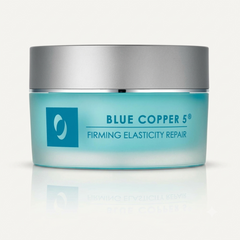
Blue Copper 5®: our signature complex — not a generic ingredient
“Copper peptide” is a category — one Osmotics created. Anyone can print it on a box today. Blue Copper 5® is ours — a proprietary, trademarked copper-peptide complex Osmotics has developed and refined over more than 25 years.
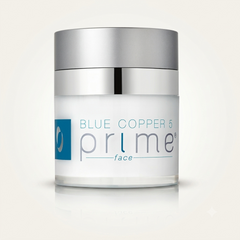
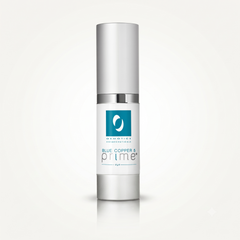
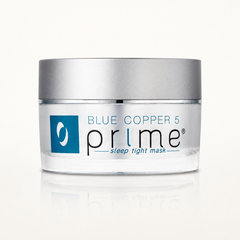
A generic copper peptide is an ingredient you buy by the drum. Blue Copper 5® is a specific, consistent formulation — dosed to a defined strength, stabilised for real efficacy, and identical from one jar to the next. Its most advanced expression, Blue Copper 5 PRIME®, carries the complex at its highest strength for mature skin.
Blue Copper 5® and Blue Copper 5 PRIME® are registered trademarks of Osmotics Cosmeceuticals.
The molecule
What a copper peptide actually is
A copper peptide is a small peptide — a short chain of amino acids — bound to a single copper ion. It occurs naturally in your body and was first isolated from human blood plasma in 1973. Your natural levels fall sharply with age, part of why mature skin repairs, renews and firms itself more slowly.
Think of it as one of the skin’s own repair signals — carrying copper, an essential cofactor, to the fibroblasts that build your skin’s support structure. It is one of the very few cosmetic actives with decades of independent, peer-reviewed literature behind it, rather than a single supplier brochure.
The evidence behind the ingredient
Fifty years of research — not a launch-year study
Dr. Loren Pickart first isolates the copper tripeptide from human plasma.
Maquart et al. show, in FEBS Letters, that the copper peptide stimulates collagen synthesis in human fibroblast cultures.
Osmotics creates the first copper-peptide product sold at retail — launching the category, dosed at studied strength.
Pickart & Margolina publish a major review in Cosmetics on the copper peptide’s role in skin regeneration and gene signalling.
Copper peptides are on every trend list. We’ve been dosing them at clinical strength for over 25 years.
What the research shows
Four things copper peptides are studied for
Firmness & structure
Support fibroblasts in producing collagen and elastin — the proteins behind bounce and resilience.
Tissue remodelling
Studied for balancing the enzymes (MMPs) that clear old, damaged collagen — keeping renewal in balance.
Renewal signalling
Genomic research indicates it modulates the expression of a large number of genes tied to skin repair.
Antioxidant support
Helps skin cope with the oxidative stress of daily sun and pollution — a key driver of visible ageing.
These describe the studied actions of the copper-peptide ingredient. Osmotics products are cosmetics; they describe and improve the appearance of skin.
The part most brands skip
An ingredient only does what its study says — if it’s there at the studied strength
A pinch of a celebrated active — enough to name on the box, far too little to do what the research showed — is what the industry politely calls “fairy-dusting.” The study was run at a specific concentration; below it, the result on the page simply doesn’t belong to the product. Think of it as a level each dose has to reach:
Illustrative comparison — the point is the gap between “present on the label” and “present at the level the research used,” not a specific percentage. Exact concentrations are proprietary.
One striking result
In comparative research, the copper peptide out-performed two icons
In a comparative human study of topical anti-agers, the copper peptide increased collagen in a majority of volunteers — reported to out-perform both vitamin C and retinoic acid.
Relative comparison of the collagen response reported in ingredient-level research on the copper peptide. Refers to the active, not the finished product.
More than one hero
Copper peptides lead. They don’t work alone.
Matrixyl® peptide complexes
Messenger peptides studied for softening the look of fine lines and supporting the skin’s matrix — used at their studied strength.
Hyaluronic acid
Deep, cushioning hydration that plumps the look of the skin’s surface.
Antioxidants
White-tea polyphenols, ergothioneine and more — to defend against the daily free-radical load that accelerates visible ageing.
Vitamin A / retinol
Where a product calls for it — at levels formulated for visible renewal with tolerability in mind.
Why Osmotics
Four things that set us apart
A proprietary complex, not a borrowed ingredient
Anyone can list “copper peptide.” Blue Copper 5® is our own trademarked complex — developed and refined since 1998, consistent in every jar.
Clinically dosed — no fairy-dusting
We formulate our actives at the level used in the research behind them, and in several products above it. The dose is whether the headline is true.
Radical transparency about proof
We separate real ingredient-level clinical data from honest consumer perception on every product page — and label in-vitro evidence as such.
Built to deliver, and to feel like prestige
Elegant textures and effective delivery — the reason people keep reaching for them, twice a day, for the years it takes to see real change.
How to read our evidence
Two kinds of proof — and we keep them apart
Independent studies of the active itself — with a panel size, a duration, a placebo control and a measurement method — carried out at the concentration we use. Where evidence is in-vitro, we say so, and never dress it up as a result on skin.
What real users reported after four or eight weeks of the finished product — the percentages and before/after photos on our pages. These reflect how people experienced the product, presented as perception, never as clinical proof of the finished formula.
See the evidence, product by product
The science is only worth as much as the proof behind it.
References. Pickart L. (1973) — first isolation of the copper tripeptide from human plasma. Maquart F.X. et al., FEBS Letters (1988) — stimulation of collagen synthesis in fibroblast cultures by the copper peptide. Pickart L. & Margolina A., Cosmetics (2017) — review of the copper peptide in skin regeneration and gene modulation.
Osmotics products are cosmetics and are not intended to diagnose, treat, cure or prevent any disease. Statements describe the appearance of skin, not its structure or function. Individual results may vary. “Osmotics,” “Blue Copper 5” and “Blue Copper 5 PRIME” are registered trademarks.