
 Serums
 Creams & Moisturizers
 Eye Care
 Cleansers & Toners
 Masks & Treatments
 Complexion & Glow
 Body & Bath



Blue Copper 5 PRIME Face — Clinical Results
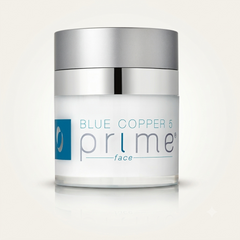
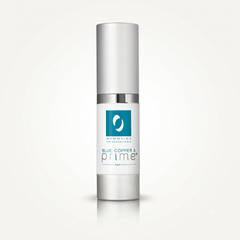
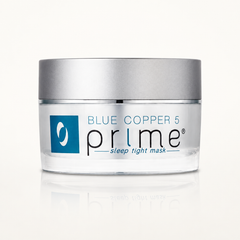
Blue Copper 5 PRIME Face
Four studied actives, the peptides among them clinically dosed — present at, or above, the concentration used in the research.
Clinical study results
In an independent clinical study at Essex Testing Clinic, Inc. (2017), 31 women used Blue Copper 5 PRIME Face Cream twice daily for six weeks. Skin was assessed with calibrated instruments at baseline, immediately after the first application, and again at weeks 4 and 6. Every instrument change reported below was statistically significant versus baseline (p<0.05).


Photography of an individual user following twice-daily use. Individual results vary.
Instrument-measured, week 6 vs baseline. Essex Testing Clinic, 31 subjects, twice daily.
Measured results over 6 weeks
| Measure | After 1st use | Week 4 | Week 6 | Improved |
|---|---|---|---|---|
| Crow’s-feet fine lines & wrinkles (Visia imaging) | −9.6% | −16.6% | −18.9% | 100% |
| Skin moisture (Corneometer) | +78.9% | +73.4% | +94.2% | 100% |
| Skin elasticity (Cutometer R2) | +22.3% | +14.5% | +28.0% | 90% |
All improvements were statistically significant versus baseline (p<0.05). “Improved” is the share of subjects showing improvement at week 6. No product-related irritation was observed on any subject at any visit.
What subjects reported at 6 weeks
| After using the product… | Agreed |
|---|---|
| The appearance of fine lines and wrinkles is reduced | 97% |
| My skin looks more moisturized | 100% |
| My skin feels more hydrated | 97% |
| My skin feels firmer | 97% |
| Overall, my skin appears firmer | 94% |
| Overall, my skin appears more radiant | 97% |
| The texture of my skin feels smoother | 98% |
| I would like to purchase this product | 94% |
Subject questionnaire, final (week 6) visit. Individual results vary.
Study design
| Laboratory | Essex Testing Clinic, Inc. — independent testing facility (2017) |
|---|---|
| Subjects | 31 women; all 31 completed the study |
| Duration | 6 weeks, twice daily (AM & PM) |
| Measures | Visia CR imaging (crow’s-feet), Corneometer (moisture), Cutometer R2 (elasticity), technician irritation grading, subject questionnaire |
| Standard | Good Clinical Practice / 21 CFR Part 50; informed consent obtained |
The ingredient evidence
Most anti-aging creams contain the right ingredients at the wrong strength. An active only does what its study says it does if it is present at the concentration that study used. Below is what is in PRIME Face, and what the research behind each active actually showed.
Matrikine peptide complex
Clinically dosed — above the level used in the researchA pairing of two matrikine peptides, palmitoyl tripeptide-1 and palmitoyl tetrapeptide-7, which signal the skin to rebuild its extracellular matrix.
| Subjects | 2 panels of 23 volunteers, aged 39–74 |
|---|---|
| Design | Half-face, placebo-controlled — the active on one side, placebo on the other |
| Regimen | Twice daily, 2 months |
| Method | Silicone-imprint skin topography |
Supporting in-vitro work on the same active: collagen I +258%, fibronectin +164%, hyaluronic acid +179%. A separate 4-month study (2 × 30 volunteers) recorded wrinkle depth −27% at 4 months.
Firming peptide (acetyl tetrapeptide-2)
Clinically dosed — an exact match to the studied levelIt works against gravity: increasing collagen and functional elastin synthesis, and overexpressing the genes behind the focal adhesions that hold skin cells together.
| Subjects | Women aged 40–60 with sagging skin and loss of elasticity |
|---|---|
| Regimen | Twice daily, 56 days |
| Also recorded | Visible lifting of the face contour — a decrease of 0.13 cm |
Artichoke-leaf peptides for hormonal ageing (Menofit®)
Studied for menopausal skinPurified peptides from artichoke leaves, developed specifically for skin undergoing hormonal ageing. They help normalise keratinocyte growth and support the dermal matrix — maintaining skin thickness, hydration and smoothness as oestrogen declines.
Supplier studies of a 3% artichoke-leaf emulsion (in vivo) and menopausal-skin cell cultures (in vitro). These figures are for the ingredient, not the finished Osmotics product.
The copper peptide
PRIME Face contains copper tripeptide — the Blue Copper peptide Osmotics has built its science on since 1998. Copper peptides are among the few actives in cosmetic science with decades of independent, peer-reviewed literature behind them, beginning with Maquart’s demonstration of collagen synthesis in fibroblast cultures (FEBS Letters, 1988).
It also carries sh-oligopeptide-1 (EGF) and Copper PCA.
What we do not claim
One of the hydration actives on the label sits below the level its own research used. We therefore make no hydration claim for it, even though the ingredient is in the formula. An ingredient earns a claim by being clinically dosed — not by appearing on the box.
Sources: Sederma, Lipotec and SILAB supplier clinical studies; Essex Testing Clinic (finished-product consumer & instrument study, 2017).