
 Serums
 Creams & Moisturizers
 Eye Care
 Cleansers & Toners
 Masks & Treatments
 Complexion & Glow
 Body & Bath


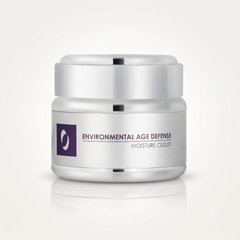
Environmental Age Defense Moisture Cloud — The Evidence
Environmental Age Defense Moisture Cloud
A barrier-repair moisturiser built on skin-identical lipids and an anti-glycation peptide.
What users saw in 4 weeks


Photography of an individual user following twice-daily use for 4 weeks. Individual results vary.
Consumer perception study over 4 weeks of twice-daily use.
The ingredient evidence — in vitro
Unlike our peptide heroes, the evidence for this formula’s actives is in vitro: measured in human cell cultures, not on volunteers. It describes what these ingredients do in the laboratory. We publish it because it is real, and we label it because it is not a measured outcome on skin.
The anti-glycation peptide
A complex built around the copper tripeptide (tripeptide-1), stabilised with hydrolysed wheat and soy proteins, and clinically dosed to its supplier use level. It has two documented functions.
1. It captures reactive carbonyl species (RCS). RCS such as HNE are produced when skin is exposed to sunlight and pollution. Keratinocytes normally neutralise them using glutathione — but UVB depletes glutathione by around 25% within four hours, after which the cell can no longer detoxify and dies. The supplier, working with the University of Milan, showed that the copper tripeptide captures RCS directly.
2. It boosts Collagen III. In a test on human fibroblast cultures, the plant proteins in the complex increased Collagen III synthesis by up to 300% in one week. Collagen III is abundant in youthful skin and is progressively replaced by Collagen I with age.
It also inhibits glycation — the cross-linking reaction that stiffens collagen and is a principal mechanism of skin ageing.
The antioxidant (Lipochroman®)
A pure synthetic antioxidant — dimethylmethoxy chromanol (Lipochroman®) — carried at the top of its recommended use range. In supplier laboratory testing it was markedly stronger than the usual benchmarks: at 0.05% it measured around 82× the antioxidant capacity of BHT, and outperformed vitamin E (tocopherol) and resveratrol in comparative assays, with dose-dependent inhibition of nitrotyrosine formation and of lipid peroxidation. Again: in vitro.
Coenzyme Q10 (ubiquinone)
Coenzyme Q10 is one of the most-studied antioxidants in skin. In a peer-reviewed study, topical CoQ10 applied around the eyes for six months penetrated the living layers of the skin, reduced oxidation, and reduced the depth of wrinkles (Hoppe et al., BioFactors, 1999; 20 subjects). This is independent literature on the ingredient — not a trial of this formula, and our use level here has not been confirmed to us as a studied dose.
The barrier system — the real point of this product
What makes this formula unusual is not a headline peptide, it is the lipid architecture. It contains all three lipid classes of a healthy stratum corneum, at meaningful, barrier-relevant levels rather than as label decoration:
| Ceramides | The lamellae’s structural backbone |
|---|---|
| Phytosterols | The cholesterol-equivalent component |
| Linoleic acid | The free fatty acid component |
| Squalane | Skin-identical emollient |
| Glycerin | Humectant |
Ceramides, cholesterol/phytosterols and free fatty acids are the three components of the intercellular lipid lamellae. Supplying all three, rather than ceramides alone, is what distinguishes a barrier-repair formula from a moisturiser that merely occludes. That is a formulation fact, not a claim — and the classes are verifiable from the ingredient list.
Also in the formula
An infrared-defence active, carnosine and allantoin. We claim no figures for these: their supplier use levels have not been confirmed to us in writing, so we cannot say they are dosed at a studied level.
With one exception, the ingredient evidence on this page is in vitro — human cell cultures, not volunteers; no human clinical study has been run on this finished formula. The exception is the coenzyme Q10 wrinkle-depth finding, which is peer-reviewed literature on the ingredient, not a trial of this product. Sources: Lipotec S.A. in-vitro data (Cebrian et al., Int J Cosmet Sci, DOI 10.1111/j.1467-2494.2005.00279.x), the Lipochroman® supplier dossier, and Hoppe et al., BioFactors 9 (1999) 371–378.